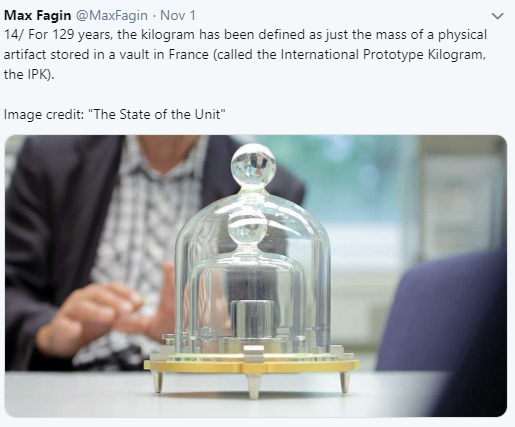
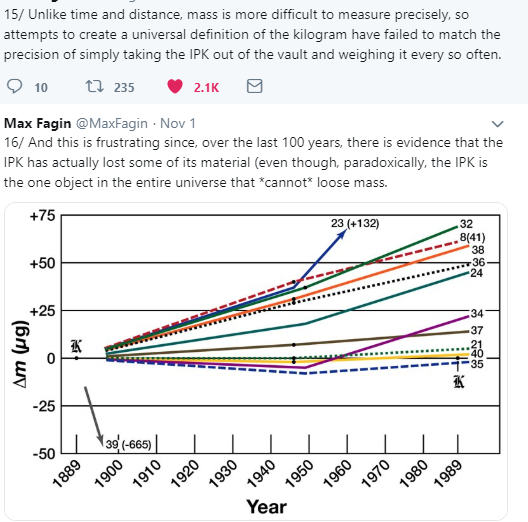
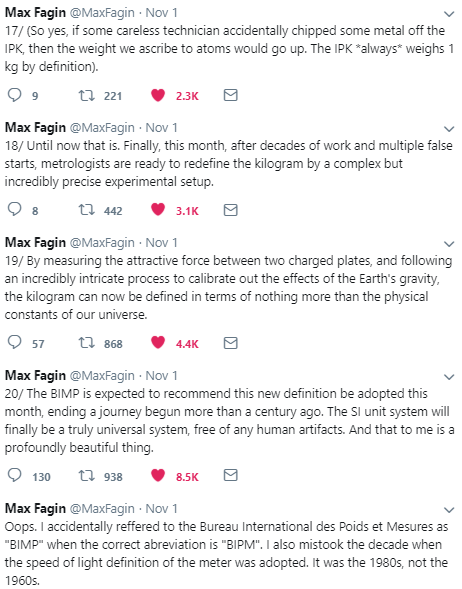
This means that we’re almost out of time for human history to contain “that time someone stole the unit of mass, and we had to catch them to get it back for the mass of everything to be well-defined again”.*
For fun theory reasons, we need someone to plan and execute a heist, and soon.
(* Well, okay, on a global scale. I’m sure this has been done for smaller local reference objects through history.)
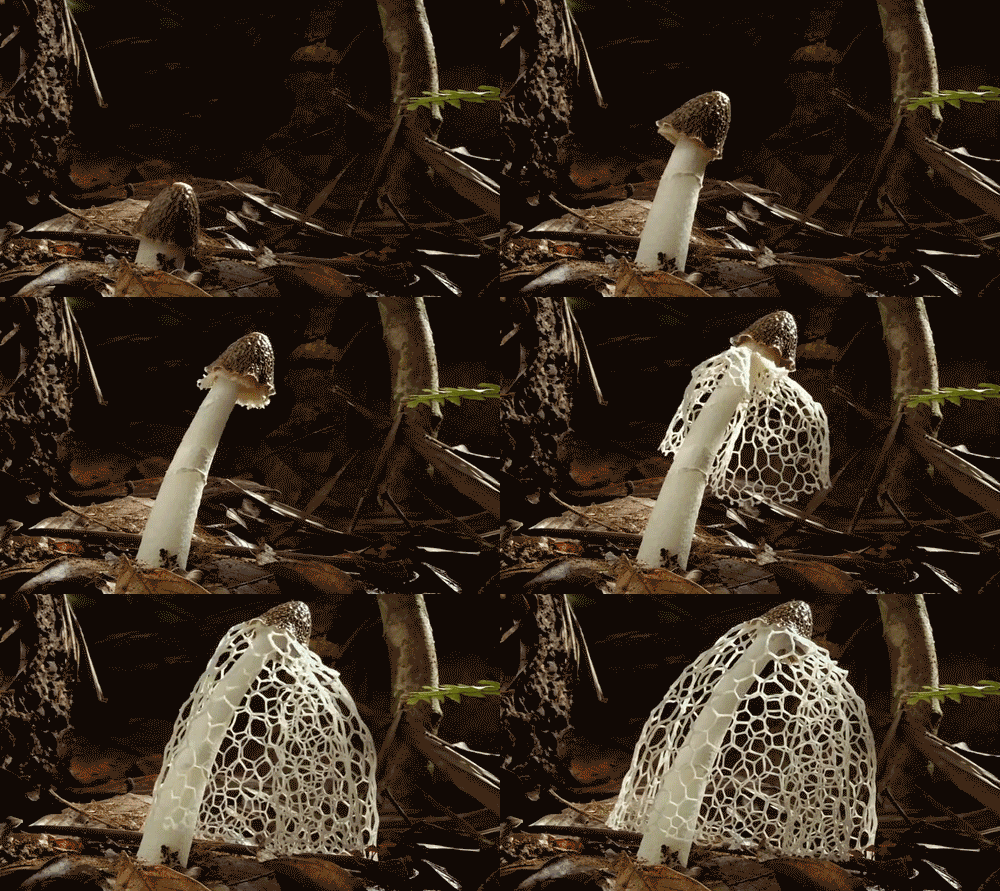
This gorgeous stinkhorn is easily separated from other veiled stinkhorns – such as Phallus indusiatus and Phallus multicolor – by its cinnabar red skirt. Like other stinkhorns, this fungus emerges from an egg-like sack, with a cap covered in a sticky, foul-smelling, spore-filled gleba, that will be eaten and carried far away by the flies that it attracts. You can see a few flies polishing off the last of the gleba here, which is mostly gone, revealing the red cap beneath.
As far as I know, the edibility of this variety is not known, but its close relative Phallus indusiatus, similar except for a pure white skirt,are considered choice edibles, while stinkhorn ‘eggs’ of all varieties are eaten, though they are not among the best culinary fungi.
Beautiful mushroom, but did they basically name it “cinnamon penis”?
YES! the entire genus is named for thier distinctly… dickish shape. P. indusiatus is edible/tasty and used to be thought to increase virility and longevity, but modern testing has been inconclusive. Here’s a gif of P. indusiatus blooming, becuase it’s still my favorite fungus:
(P. indusiatus roughly translates to “Penis with a pretty skirt)
I have the fantastic honor to have a public-facing studio, The Image Lab, at @WIDiscovery, where professors just show up and four hours later, I’ve got a comic made about our conversation.
Professor David Bart came by today and we talked gentians and local WI orchids.
Researchers have argued that pointy eggs are common to cliff-nesting
birds because they roll in a circle and are less likely to tumble off an
edge. Or that asymmetric eggs pack together more easily and would allow
females with large clutches to incubate their broods efficiently. Or
that spherical eggs are stronger and less prone to breaking, or use the
least amount of shell for a given volume, which would be useful for
birds that can’t get enough calcium in their diet.
“There are a
lot of hypotheses, but no conclusive explanation or theory,” says
Stoddard, who’s an evolutionary biologist based at Princeton University.
“It was a good puzzle.”
To solve it, Stoddard teamed up with L. Mahadevan,
a biophysicist at Harvard University who has studied “how leaves
ripple, how tendrils coil, and how the brain folds, among other things.”
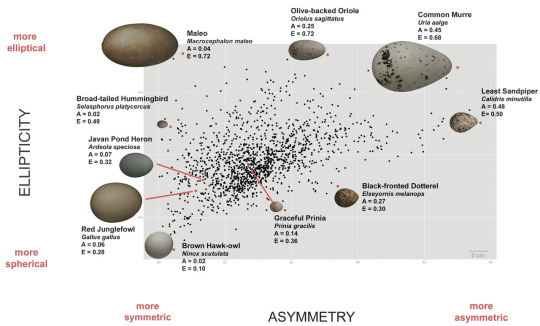
He realized that all eggs could be described according to two simple
characteristics—how asymmetric they are, and how elliptical they are.
Measure these traits, and you can plot every bird egg on a simple graph.
They did that for the eggs of 1,400 bird species, whose measurements
Stoddard extracted from almost 50,000 photos. It was the resulting graph
that revealed the left-field nature of chicken eggs.
She also has an Etsy shop where she sells beautiful prints of minimal marine art. Her pieces depict the unique scale patterns of different sharks and include information on each shark type with every order.
Melissa’s Twitter said she is using the proceeds to study in Antarctica!
if you ever want the experience of being totally baffled by text written in your native language, I highly recommend trying to wring useful information out of a guide written by and for experts in a scientific field you have no formal training in
sure man, I’ll just check if those macropunctures in the mesopleuron are accompanied by an omaulus, or if the clypeus has ferruginous markings, no problem
my god but I get mad when someone flippantly dismisses important scientific progress because you can make it sound dumb by framing it the right way.
For a start, of course a lot of science sounds dumb. Science is all in the slogging through the minutiae, the failures, the tedious process of filling in the blank spaces on the map because it ain’t ’t glamorous, but if someone doesn’t do it, no one gets to know for sure what’s there.
Someone’s gotta spend their career measuring fly genitalia under a microscope. Frankly, I’m grateful to the person who is tackling that tedium, because if they didn’t, I might have to, and I don’t wanna.
But let’s talk about why we should care about this particular science and spend money on it. (And I’ll even answer without even glancing at the article.)
Off the top of my head?
-advances in robotics
-advances in miniature robotics
-advances in flight technology
-advantages in simulating and understanding the mechanics and programming of small intelligences
-ability to grow crops in places uninhabitable by insects (space? cold/hot? places where honeybees are non-native and detrimental to the ecosystem?)
-ability to improve productivity density of crops and feed more people
-less strain on bees, who do poorly when forced to pollinate monocultures of low nutrition plants
-ability to run tightly controlled experiments on pollination, on the effects of bees on plant physiology, on ecosystem dynamics, etc
-fucking robot bees, my friend
-hahaha think how confused those flowers must be
Also worth keeping in mind? People love, love, love framing science in condescending and silly sounding terms as an excuse to cut funding to vital programs. *Especially* if it’s also associated with something (gasp) ‘inappropriate’, like sex or ladyparts. This is why research for a lot of women’s issues, lgbtq+ issues, minorities’ issues, and vulnerable groups in general’s issues tends to lag so far behind the times. This is why some groups are pushing so hard to cut funding for climate change research these days.
Anything that’s acquired governmental funding has been through and intensely competitive, months-to-years long screening by EXPERTS IN THE FIELD who have a very good idea what research is likely to be most beneficial to that field and fill a needed gap.
Trust me. The paperwork haunts my nightmares.
So, we had a joke in my lab: “Nice work, college boy.” It was the phrase for any project that you could spend years and years working on and end up with results that could be summed up on a single, pretty slide with an apparently obvious graph. The phrase was taken from something a grower said at a talk my advisor gave as a graduate student: “So you proved that plants grow better when they’re watered? Nice work, college boy.”
But like, the thing is? There’s always more details than that. And a lot of times it’s important that somebody questions our assumptions.
A labmate of mine doing very similar research demonstrated that our assumptions about the effect of water stress on plant fitness have been wrong for years because *nobody had thought to separate out the different WAYS a plant can be water stressed.* (Continuously, in bursts, etc.). And it turns out these ways have *drastically different effects* with drastically different measures required for response to them to keep from losing lots of money and resources in agriculture.
Nice work, college boy. :p
Point the second: surprise! Anna Haldewang is an industrial design student. She developed this in her product design class. And, as far as I can tell, she has had no particular funding at all for this project, much less billions of dollars.
‘grats, Anna, you FUCKING ROCK.
ps: On a lighter note, summarizing research to make it sound stupid is both easy AND fun. Check out @lolmythesis – I HIGHLY RECOMMEND. :33
I’d also like to chime in that a chunk of my family are apple farmers, and one thing I learned visiting them is that you can’t always let bees pollinate. With certain apple varieties, people have to go out with little paintbrushes to pollinate them by hand, because if they cross-pollinate with the wrong variety the apples won’t come out the same. Beebots could potentially be a huge time-saver at that task, because depending on how the algorithms work, you could just tell them “Don’t go into the Gala field next door” and let them do the job more efficiently than you without having to worry about getting weird mutant apples.
Also holy shit all science is not interchangeable. Nobody got up one morning and said “instead of saving the bees I’m going to build a bee robot.”
The only problem with those robots is a marketing one. Make ‘em anthropomorphic, like pixies, and people would be all over that shit and want them as pets.
I feel morally obligated to remind everyone, when I see discourse like this, that there are vested interests in destroying the public’s faith in
Evidence-based statements
Publicly-funded science
Critical examination of the media
Affection and investment for the natural world
And this is something I’ve been explaining for years.
And next thing you know it’s 2017 and everyone is surprised that the CDC has been told not to use the words “vulnerable” or “evidence-based” when writing their budgets. And the people running the world are able to deny the effects of climate change while the waters rise. This is how you get hurricanes while people tell you there aren’t any hurricanes. And how conspiracy theories are more attractive than the truth.
We got here on purpose because we wanted to be here. Because cynicism seemed cooler than wonder. Because of course the world is broken so why bother?
Because we didn’t want to be like those wide-eyed nerds and their silly robot bees.
I think I may have rebligged the root post before without particularly examining how counter to my values it is. Though, I do truly hope that scientific research can fix the woes of ailing bees before we have to implement any robot army based solutions.
every time i see this im reminded of the “shrimp on a treadmill” thing that people were lambasted for being a “waste of taxpayer money”. DESPITE the fact that it was like a few thousand dollars MAX and done by a student in university (with a grant provided BY THE UNIVERSITY) to study how the negative water quality in the gulf of mexico caused by the bp spill would affect oxygen processing in shrimp.
which is a SIGNIFICANT part of the fishing industry down there and how some folks literally make their living. it also ties into ecology and conservation since you don’t want to overfish shrimp populations that arent going able to bounce back from it. you also dont want to start resorting to fishing methods that will do more harm to to the environment to try to get bigger hauls to hit basic demand if theres nothing there to catch.
my own research was mostly done out of pocket w a few hundred dollars grant despite the fact that it involved potentially an entirely new mode of sensory input as of yet undiscovered by science that had LOADS of potential applications in biology and robotics. but boil it down to “put a scorpion in a maze in the dark to see if it bumps into walls” on paper and people just kinda roll your eyes at you. hell, i even built my own lab apparatuses and paid for the materials with money from my food budget. (bulk dry spaghetti saved my life)
anytime you see a “lol this science was a waste of money” it’s almost always blatant propaganda to encourage the cutting back of research and the justification of budget cuts. dig a little deeper into “dumb studies” and there’s usually some very nifty applications or hypotheses being tested that have real world applications concerning problems that exist RIGHT NOW.
not to say you shouldnt think critically about WHY something is being studied, but the studies you usually have to look out for are the ones privately funded by groups looking to push an agenda (ones from christian “family” groups on homosexuality/lgbt issues, stuff from people with connections to big oil/etc who do studies on global warming, or on the other end of the political spectrum something from pro-marijuana lobbyist about how marijuana will cure -insertailmenthere-). there could still be good raw data in these studies, assuming it hasnt been altered or data sets excluded, but it will be presented in such a way to make their point so you have to keep that in mind (as well as their methodology and things that could have been intentionally or unintentionally skewing the data, but that goes for any study)








 A Pretty Taste for Paradox