Researchers have argued that pointy eggs are common to cliff-nesting
birds because they roll in a circle and are less likely to tumble off an
edge. Or that asymmetric eggs pack together more easily and would allow
females with large clutches to incubate their broods efficiently. Or
that spherical eggs are stronger and less prone to breaking, or use the
least amount of shell for a given volume, which would be useful for
birds that can’t get enough calcium in their diet.
“There are a
lot of hypotheses, but no conclusive explanation or theory,” says
Stoddard, who’s an evolutionary biologist based at Princeton University.
“It was a good puzzle.”
To solve it, Stoddard teamed up with L. Mahadevan,
a biophysicist at Harvard University who has studied “how leaves
ripple, how tendrils coil, and how the brain folds, among other things.”
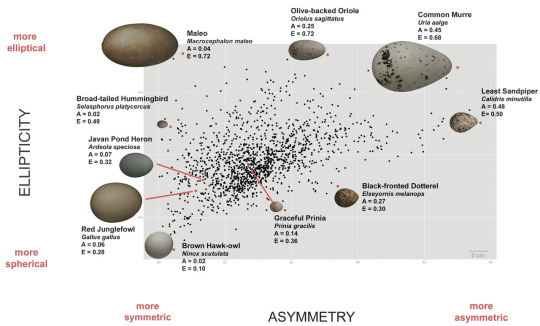
He realized that all eggs could be described according to two simple
characteristics—how asymmetric they are, and how elliptical they are.
Measure these traits, and you can plot every bird egg on a simple graph.
They did that for the eggs of 1,400 bird species, whose measurements
Stoddard extracted from almost 50,000 photos. It was the resulting graph
that revealed the left-field nature of chicken eggs.
the northern flicker that lives in my neighborhood just landed on the side of the house, peered into my living room window, then knocked on it experimentally, presumably in case there were tasty grubs concealed within. And then of course my dog thought someone was knocking on the door and threw such a fit that she startled the flicker into flying away
The ocellated turkey is a species of turkey residing primarily in the Yucatán Peninsula. It is a relatively large bird, at around 70–122 cm long.The body feathers of both sexes are a mixture of bronze and green iridescent color. Turkeys spend most of the time on the ground and often prefer to run to
escape danger through the day rather than fly, though they can fly
swiftly and powerfully for short distances as the majority of birds in
this order do in necessity. Roosting is usually high in trees away from
night-hunting predators such as jaguars and usually in a family group. The Ocellated Turkey is a generalist in terms of its feeding habits.
They are known to feed on a wide variety of forage including but not
limited to insects such as beetles, moths, and leafcutter ants, grass
seeds, nuts, and leaves.
I was being sternly scolded by a pair of wrens, and when I took a step towards them the clump of ferns in front of me erupted, with fledgling wrens whirring in all directions
K and I took the dog for a hike this morning and now I have a Birding Conundrum. We heard, distinctly and repeatedly, a Great Horned Owl calling, accompanied by the sound of baby owls doing that shrieking begging call, and were of course trying to spot the nest, but instead of a Great Horned, a Barred Owl flew past from the direction the calls had come from.
It was close enough to be 100% sure on the ID, and in fact had a dead something in its talons that it paused on a tree limb to eat right in front of us, so I have no doubt we saw a Barred Owl. But Barred Owls have a distinctive call that is quite different from what we heard, and, although it seems unbelievable, my only explanation for this is that we stumbled across a Barred Owl in the act of disturbing the nest of a Great Horned Owl (or possibly vice versa? the chicks’ calls are very similar).
Ornithologist Jerry McGahan is pictured with a 6 month old Andrean Condor, the largest flying bird on earth. Photographed by the Helen and Franck Schreider.
Another version of this photo made it to the cover of National Geographic.



 A Pretty Taste for Paradox